Calls for Mercy Grow as Christa Pike Reportedly Regains Consciousness — What Happens Next?
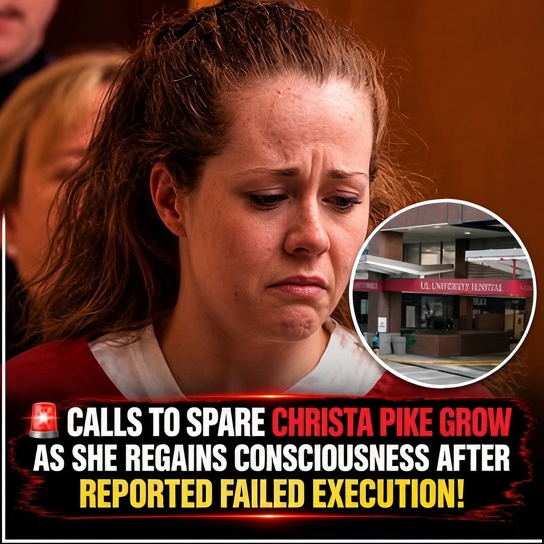
CALLS FOR MERCY GROW AMID CLAIMS CHRISTA PIKE REGAINED CONSCIOUSNESS AFTER A REPORTED FAILED EXECUTION — A CASE THAT STILL HAUNTS TENNESSEE ⚖️💔
A reported medical recovery. Renewed questions about the death penalty. Emotional calls for mercy. And the memory of a 19-year-old woman whose life was taken before she had the chance to discover what her future might hold.
The case involving Tennessee death row inmate Christa Pike is once again at the center of a difficult public debate. Claims circulating about her condition following an alleged unsuccessful execution attempt have prompted questions about whether her death sentence should ultimately be carried out.
For some, the reported circumstances raise urgent concerns about human suffering, consтιтutional protections, and the morality of capital punishment. For others, the focus remains on the seriousness of the crime, the conviction reached in court, and the question of whether a lawfully imposed sentence should be enforced.
Yet amid the growing controversy, one essential point must remain clear: reports about the alleged execution attempt, Pike’s medical recovery, and any organized clemency campaign must be distinguished from independently confirmed facts.
This is a case where the truth matters—and where the human cost should never be forgotten.
🏥 REPORTS OF RECOVERY RAISE SERIOUS QUESTIONS
Accounts circulating online suggest that Pike regained consciousness following a reported failed execution attempt, with some claims indicating that she has become more responsive and is showing signs of physical improvement.
If these developments are confirmed, they could become an important part of the discussion surrounding her medical condition and the events that reportedly occurred.
But recovery is not always straightforward. Regaining consciousness does not necessarily mean that someone has fully recovered, and descriptions of improved communication or movement cannot establish the extent of any lasting injuries.
Without reliable medical documentation or an official statement, it is not possible to determine the full nature of Pike’s condition, whether she continues to experience complications, or what long-term effects she may face.
Those uncertainties matter.
If an execution procedure failed or resulted in unexpected medical consequences, the circumstances would deserve careful, independent examination. Investigators would need to establish what happened, whether established procedures were followed, and whether any failures occurred.
Such questions should not be answered through rumor or emotional speculation. They require evidence, transparency where legally possible, and a process capable of distinguishing documented findings from unverified claims.
The same principle applies to reports that Pike has regained consciousness. Her condition should be described accurately, without exaggerating either the severity of her injuries or the extent of her recovery.
At the heart of the matter is a fundamental question: If the state intends to carry out a death sentence, what safeguards must be in place to ensure that the procedure complies with the law and applicable consтιтutional protections?
That question reaches beyond one prisoner. It touches the responsibilities of government whenever it exercises the power to impose a person’s death.
⚖️ SHOULD CHRISTA PIKE RECEIVE MERCY?
The possibility of another execution attempt has brought renewed attention to the debate over clemency, the death penalty, and whether extraordinary circumstances should change the course of a case.
Those who favor mercy may argue that an execution attempt involving serious complications—if established by reliable evidence—would raise profound ethical and legal questions. They may believe that the state has a responsibility to examine the circumstances fully before proceeding further.
Some opponents of capital punishment also argue that no execution can be justified, regardless of the crime or the pᴀssage of time. For them, the case presents another opportunity to question whether the death penalty can ever be administered in a manner consistent with human dignity.
Others reach a different conclusion.
They point to the gravity of the crime, Pike’s conviction, and the years of legal proceedings that followed. They argue that the seriousness of a crime and the suffering endured by its victim’s loved ones must remain central to any discussion about punishment.
These positions reflect a much broader disagreement about justice, accountability, and the role of the state.
But it is important to separate public debate from legal authority. Calls for clemency do not automatically change a sentence, and public outrage or sympathy does not determine the outcome by itself. Any decision about Pike’s legal future must follow the applicable legal procedures and be made by the authorities empowered to act.
The key questions are difficult: What circumstances justify mercy? What obligations does the state have after a reported procedural failure? And how should a justice system balance accountability, consтιтutional safeguards, and humanity?
There are no easy answers. But there should be a commitment to examining the facts before reaching conclusions.
🚨 THE CRIME THAT CHANGED SO MANY LIVES
To understand why the case continues to provoke such intense reactions, it is necessary to return to January 1995.
Nineteen-year-old Colleen Slemmer was murdered in Knoxville, Tennessee. Christa Pike was convicted of her murder and sentenced to death in 1996.
The crime shocked the community and became the foundation of a case that would remain in the public eye for decades.
For people following the story, the legal proceedings have raised questions about punishment, responsibility, and the limits of the criminal justice system. But for those who loved Colleen, the central tragedy is much more personal.
A young woman lost her life.
Her future ended before she had the chance to experience the many stages of adulthood that most people hope to reach. Her loved ones were left to live with an absence that no court ruling could reverse.
As the years pᴀssed, the case continued to attract attention. But every new discussion about Pike’s sentence returns to the same devastating fact: Colleen Slemmer was 19 years old when she was killed.
She was not a legal argument. She was not a headline. She was not simply a name attached to a death penalty case.
She was a person whose life mattered.
💔 WHILE THE WORLD DEBATES MERCY, COLLEEN MUST NOT BE FORGOTTEN
Colleen was only 19.
At that age, so much of life remains ahead. There are goals to pursue, friendships to strengthen, new experiences to discover, and decisions that gradually shape the person someone becomes.
Colleen should have had the opportunity to grow older.
She should have had the chance to celebrate future birthdays, develop new interests, build relationships, and create memories with the people she loved. She should have been able to discover what kind of future she wanted and make choices about the life she would lead.
No one can know precisely what that future would have contained. But she deserved the opportunity to live it.
Instead, her loved ones have had to face decades without her.
For families affected by violent crime, time can bring changes, new experiences, and moments of healing, but it cannot restore the person they lost. Important dates may return year after year. Memories may remain vivid. And public attention can bring a painful reminder of events that changed their lives forever.
It is impossible to know every private emotion Colleen’s family has experienced throughout the years. Their grief should not be used as a prop in a public argument or treated as something outsiders can fully understand.
What the public can do is remember Colleen with dignity, recognize the lasting consequences of her death, and ensure that discussions about Pike do not erase the victim.
Compᴀssion for a condemned prisoner and remembrance of a murder victim are not mutually exclusive.
A person can question the death penalty while acknowledging the devastating harm caused by the crime. Someone can believe that a sentence should be enforced while still insisting that all legal procedures must be followed. And someone can call for mercy without pretending that Colleen’s life and the suffering caused by her death are unimportant.
The challenge is to discuss justice without losing sight of humanity.
🕊️ MERCY, ACCOUNTABILITY, AND THE MEANING OF JUSTICE
Capital punishment remains one of the most divisive issues in American public life because it forces society to confront difficult questions about punishment, morality, and the authority of government.
Supporters often argue that the most serious crimes deserve the most serious penalties and that victims and their loved ones deserve a justice system capable of imposing lawful consequences.
Opponents question whether the state should have the power to execute prisoners at all. They raise concerns about irreversible mistakes, unequal treatment, procedural failures, and the moral implications of government-sanctioned death.
Between these positions are people who may support capital punishment in principle but believe that particular circumstances warrant a closer examination of whether an execution should proceed.
Reports of a failed execution attempt, if verified, could intensify these questions. But the facts must be established before the incident can responsibly be used to support any conclusion about Pike’s sentence.
A serious medical complication would not automatically determine the legal outcome. Nor should the seriousness of the original crime be used as a reason to dismiss legitimate questions about whether the state followed the law.
Both issues deserve careful consideration.
Accountability means taking the crime seriously. It also means expecting public insтιтutions to follow established rules, investigate credible concerns, and explain their actions through appropriate processes.
Justice cannot be reduced to a single emotional reaction. It requires evidence, lawful procedures, and an honest acknowledgment of the people whose lives have been changed forever.
🔎 WHAT NEEDS TO BE ESTABLISHED BEFORE THE NEXT DECISION?
As discussion about Pike continues, several questions deserve clear answers based on reliable information.
First, what actually happened during the reported execution attempt? The circumstances, timeline, and any procedural issues should be established through credible records and an appropriate investigation.
Second, what is Pike’s verified medical condition? Claims about consciousness, communication, mobility, and lasting injuries should not be treated as definitive without reliable supporting information.
Third, have formal clemency efforts been made? Calls for mercy on social media are not necessarily the same as a formal application or an official review. Any claim about the status of such efforts requires confirmation.
Finally, what happens next under the law? Any future decision concerning Pike’s sentence or a possible execution must be grounded in the applicable legal framework and the decisions of the authorities responsible for the case.
These questions are not merely technical details. They determine whether the public is responding to established facts or to a story that may have changed as it spread online.
In a case this emotionally charged, accuracy is not optional. It is essential.
💔 MY TAKE: A CALL FOR MERCY SHOULD NEVER ERASE THE VICTIM
The reported medical recovery deserves careful scrutiny. Any claims about a failed execution should be verified, and credible concerns about the procedure should be investigated. Calls for clemency deserve to be discussed honestly, with an understanding of what is confirmed and what remains uncertain.
But the conversation must also remember Colleen Slemmer.
She was 19 years old when her life was taken. She never got to experience the future that should have been hers. Her loved ones were left with a loss that cannot be undone by a court decision, a change in policy, or the pᴀssage of time.
Whatever happens to Christa Pike, Colleen’s life should never become a secondary detail in a debate about punishment.
The public can ask whether mercy is appropriate without forgetting the crime. It can question the death penalty without minimizing the victim’s loss. It can demand that the law be followed while recognizing that no legal process can return the years Colleen was denied.
The case may continue to generate headlines. The legal questions may remain unresolved. And people will continue to disagree about what justice should look like.
But one thing should never be lost in the debate: Colleen Slemmer was a young woman who deserved the chance to live her life.
Her memory deserves respect. Her story deserves accuracy. And her life deserves to be remembered for more than the controversy surrounding the woman convicted of killing her.
🕊️ HER NAME WAS COLLEEN SLEMMER.
💔 SHE WAS ONLY 19 YEARS OLD.
⚖️ THE FACTS MUST MATTER. JUSTICE MUST FOLLOW THE LAW.
🕊️ AND THE VICTIM MUST NEVER BE FORGOTTEN.
Whatever the future holds for Christa Pike, Colleen Slemmer’s life mattered—and it always will.
✓ Team
CALLS FOR MERCY GROW AMID CLAIMS CHRISTA PIKE REGAINED CONSCIOUSNESS AFTER A REPORTED FAILED EXECUTION — A CASE THAT STILL HAUNTS TENNESSEE ⚖️💔 A reported medical recovery….