Christa Pike Reportedly Speaking in Full Sentences After Alleged Failed Execution — What We Know So Far
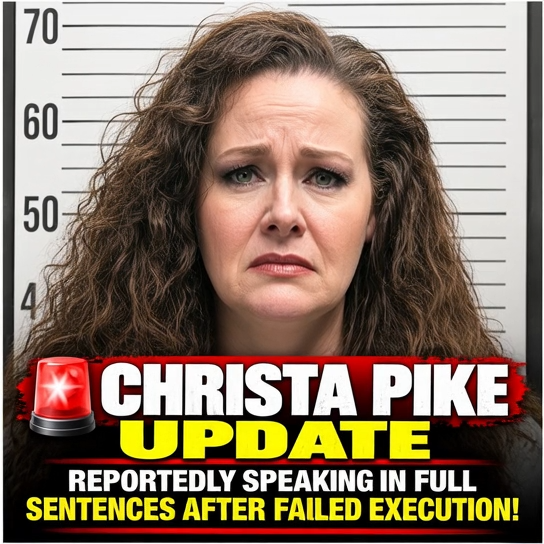
🚨 CHRISTA PIKE IS NOW SPEAKING IN FULL SENTENCES AFTER TENNESSEE’S FAILED EXECUTION — BUT HER LAWYERS SAY THE BIGGEST QUESTIONS REMAIN UNANSWERED ⚖️💔
Weeks after Tennessee’s attempt to execute her went terribly wrong, Christa Pike is reportedly making progress in her recovery. She can now speak in full sentences and is walking more independently, according to reports citing her attorney. But beneath these encouraging developments lies a much more troubling question: What lasting physical, cognitive, or psychological harm might she have suffered?
The latest update in Christa Pike’s case is drawing renewed attention to an extraordinary episode that has raised serious questions about Tennessee’s execution procedures, medical care, and the future of one of the state’s most controversial death penalty cases.
On September 30, 2026, officials attempted to execute Pike by lethal injection at Riverbend Maximum Security Insтιтution in Nashville. Instead of dying, she survived after receiving two doses of pentobarbital and was rushed to a hospital in critical condition.
What followed was a medical emergency that left her family of attorneys, legal representatives, and observers facing uncertainty about whether she would survive at all.
Now, nearly a month later, reports indicate that Pike has made significant progress. Yet her recovery is far from a closed chapter, and the legal questions surrounding the failed procedure remain unresolved.
🏥 A REMARKABLE RECOVERY — BUT WHAT IS HAPPENING BEHIND THE HEADLINES?
According to reports published in late October, Pike’s attorney said she is now able to communicate in full sentences and walk more independently. These developments represent progress compared with the condition her legal team described during the first days after the attempted execution. <Cite refs={[“turn316577search13″,”turn316577search19”]}/>
When Pike was initially taken to the hospital, her condition was reportedly so serious that her attorneys feared she might not survive. She required a ventilator and intensive medical care. Her lawyers later described severe injuries to her arms, along with other complications that developed during her hospitalization.
On October 6, her attorneys announced that she had regained consciousness and was speaking. At that point, they emphasized that her prognosis remained unclear and that a prolonged recovery was expected. <Cite refs={[“turn316577search1″,”turn316577search11”]}/>
The improvement in her speech is now attracting particular attention because communication can be an important part of ᴀssessing recovery after a critical medical event.
However, speaking clearly does not necessarily mean that every aspect of a person’s health has returned to normal. Physical strength, memory, concentration, emotional well-being, and other cognitive functions may recover at different rates.
Pike’s attorney has reportedly said that doctors still need time to determine whether she has suffered lasting cognitive or psychological harm. A clearer ᴀssessment could take another month or longer. <Cite refs={[“turn316577search13″,”turn316577search19”]}/>
For now, the encouraging reports should be understood alongside the continuing uncertainty.
Pike appears to be making progress, but the full extent of her recovery remains unknown.
🚨 SEPTEMBER 30: THE EXECUTION THAT DID NOT END AS PLANNED
The events that led to this extraordinary situation began inside Tennessee’s execution chamber.
Pike, now 50, was scheduled to die for the 1995 murder of 19-year-old Colleen Slemmer. During the September 30 procedure, officials administered two doses of pentobarbital, but Pike survived and was transported for emergency treatment. <Cite refs={[“turn316577search4″,”turn316577news23”]}/>
The failure has prompted scrutiny of the state’s execution procedures.
Court filings and concerns raised by Pike’s legal team have focused on the intravenous lines used during the procedure and whether the drugs were administered as intended. Questions have also been raised about the response once it became clear that the execution had not proceeded as expected.
These issues are serious, but it is important to distinguish allegations and concerns from final investigative findings. The complete explanation for what happened must come from reliable evidence and the appropriate review process.
The incident has also raised broader questions about how prison officials respond when an execution encounters a medical emergency.
An execution is intended to be a controlled state procedure. When it fails and the person being executed requires emergency medical treatment, the consequences extend beyond the immediate medical crisis.
For Pike, those consequences have included hospitalization, physical injuries, uncertainty about her future health, and a new legal battle over the state’s actions.
⚖️ COULD HER CONDITION CHANGE THE LEGAL FIGHT?
Pike’s reported recovery is unfolding alongside significant legal questions.
Her attorneys have been seeking to preserve evidence connected to the failed execution, including medical equipment, records, pH๏τographs, recordings, and communications that could help establish what happened. On October 7, a Tennessee judge ordered officials to preserve evidence related to the procedure. <Cite refs={[“turn316577search18”]}/>
That order matters because a detailed reconstruction of the events may depend on evidence that could otherwise be lost, altered, or discarded.
The legal team may need time to evaluate Pike’s injuries and determine how the reported medical consequences affect any consтιтutional challenges. But no court outcome should be ᴀssumed in advance.
The central questions include whether the execution followed required procedures, what caused the failure, whether officials responded appropriately to the emergency, and what legal remedies may be available.
Her physical recovery alone will not determine the answers. Any court considering the case will need to examine the applicable law and the evidence.
Meanwhile, Tennessee Governor Bill Lee suspended scheduled executions for the remainder of 2026 and ordered an independent review following the incident. Pike’s failed execution has therefore become part of a wider examination of the state’s execution practices. <Cite refs={[“turn316577search0″,”turn316577search12”]}/>
Whether those developments will ultimately change Pike’s sentence or the possibility of another execution attempt remains uncertain.
💔 BUT THERE IS ANOTHER NAME THE WORLD MUST NOT FORGET: COLLEEN SLEMMER
As attention focuses on Pike’s medical condition and legal future, the young woman at the center of the original case must not disappear from the story.
Her name was Colleen Slemmer.
She was 19 years old when she was murdered in Knoxville, Tennessee, in January 1995. Pike was convicted in connection with Slemmer’s death and sentenced to death in 1996. <Cite refs={[“turn316577search4″,”turn316577news23”]}/>
Colleen was more than a name in a court file or a victim mentioned in headlines. She was a young woman whose life ended before she could experience the decades that followed.
She never had the opportunity to discover what adulthood might bring, pursue the ambitions she may have held, or grow older alongside the people who loved her.
Her family has lived with the consequences of her death for more than three decades. No legal proceeding, medical update, or public controversy can restore the future she lost.
Remembering Colleen does not require ignoring the questions raised by Pike’s failed execution. Both matters deserve serious attention: the life taken in 1995 and the state’s responsibility to follow lawful procedures decades later.
A fair examination of the case must be able to acknowledge the suffering caused by the original crime while also asking difficult questions about what happened during the execution attempt.
🕊️ TWO STORIES, ONE CASE, AND MANY UNANSWERED QUESTIONS
Today, Pike’s story is focused on survival, recovery, and the legal consequences of a procedure that did not end as intended.
Her reported ability to speak in full sentences offers a sign of progress. Yet doctors still need time to determine whether the ordeal caused lasting harm, and her attorneys continue to face unanswered questions about the execution itself.
Colleen Slemmer’s story is different. Her life cannot be recovered, and the loss experienced by those who loved her remains a permanent part of this case.
The challenge for the public is to follow the developments without allowing one story to erase the other.
Medical updates should be verified. Allegations about the execution should be investigated. Legal conclusions should be left to the evidence and the courts. And Colleen’s name should remain central to any discussion of why this case began.
💔 THE QUESTION THAT REMAINS
Christa Pike is reportedly speaking in full sentences and walking more independently. Those developments mark meaningful progress after a medical crisis that once left her survival uncertain.
But the most important questions remain unanswered: Will she recover fully? Will doctors identify lasting cognitive or psychological effects? What will the investigation reveal about the failed execution? And how will the courts respond to the circumstances surrounding it?
No one should pretend those answers are already known.
As the legal process continues, one fact remains unchanged: Colleen Slemmer was only 19 when her life was taken. Her future was lost, and her family has carried that grief for decades.
Her name was Colleen Slemmer. She was 19 years old. She deserved the chance to live her life.
Her story must never be forgotten—even as the world watches what happens next to Christa Pike.
This article is based on published reports and statements attributed to Pike’s legal team. Her long-term medical prognosis and the final findings of the investigation remain uncertain. Pike was convicted of Slemmer’s murder; the allegations and legal questions concerning the 2026 execution attempt remain separate matters.
✓ Team
🚨 CHRISTA PIKE IS NOW SPEAKING IN FULL SENTENCES AFTER TENNESSEE’S FAILED EXECUTION — BUT HER LAWYERS SAY THE BIGGEST QUESTIONS REMAIN UNANSWERED ⚖️💔 Weeks after Tennessee’s…