“God’s Will?” Christa Pike’s Supporters Reportedly Plead With Tennessee Not to Attempt Another Execution
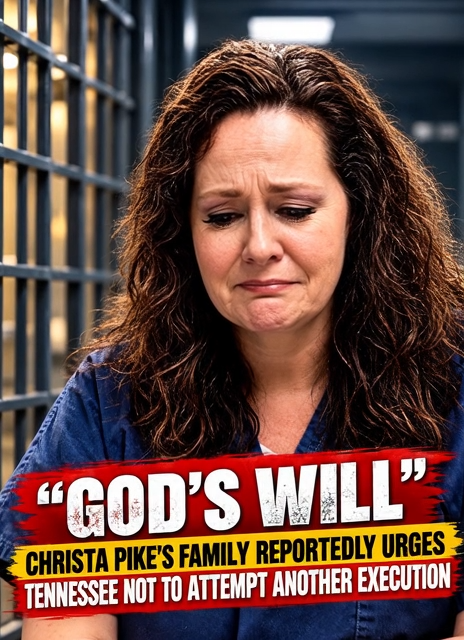
“GOD’S WILL?” CHRISTA PIKE’S FAMILY REPORTEDLY PLEADS WITH TENNESSEE NOT TO ATTEMPT ANOTHER EXECUTION ⚖️💔
One execution attempt. A life that reportedly did not end as expected. And a question that has left people confronting the difficult boundaries between faith, mercy, punishment, and justice.
As claims circulate about Christa Pike’s alleged survival of a lethal-injection procedure, attention has turned to what Tennessee might do next—and whether another execution attempt should ever take place.
According to the account provided, members of Pike’s family and supporters are urging state officials not to put her through another attempt. Some reportedly view her survival through the lens of faith, raising a deeply personal question: Could this be a second chance at life?
But the story also carries another painful reality. Pike was sentenced to death for the 1995 murder of 19-year-old Colleen Slemmer, whose life was taken decades ago and can never be restored.
Before drawing conclusions, an important distinction must be made: the reported execution incident, the family’s alleged appeal, and the claimed actions by Tennessee officials require independent confirmation through reliable reporting and official records. The events described below should not be treated as verified facts without that confirmation.
🙏 FAITH, FAMILY, AND THE MEANING OF A SECOND CHANCE
For families facing the possibility of losing a loved one, faith can become an important source of strength. It can shape how they understand unexpected events, endure uncertainty, and find meaning during moments that seem impossible to explain.
If Pike’s relatives believe that her reported survival represents divine intervention, that interpretation may carry profound personal significance for them.
But describing an event as “God’s will” is a matter of religious belief, not something that can be established as an objective fact.
People may interpret the same event in very different ways. Some may see a reason to reconsider a sentence. Others may view it as an unexpected medical or procedural outcome that must be examined through evidence and the law.
The question of what happens next cannot be resolved by faith alone, nor should a family’s religious convictions be dismissed simply because others interpret events differently.
At the heart of the reported appeal is a difficult request: that Tennessee reconsider whether another execution attempt should proceed and whether a different legal outcome could be justified.
According to the account provided, Pike’s attorneys have sought to have her death sentence commuted to life imprisonment without the possibility of parole. Any such request, its current status, and the precise arguments supporting it would need to be confirmed through official legal records.
⚖️ WHY ANOTHER EXECUTION ATTEMPT WOULD RAISE SERIOUS QUESTIONS
An unsuccessful execution procedure presents legal and ethical questions that go beyond the original sentence.
If an execution attempt genuinely failed, authorities would need to establish exactly what occurred, examine the procedure, and determine the legal consequences. The details would matter: what the medical and official records show, whether the prisoner experienced injury or suffering, and what consтιтutional protections apply.
The Eighth Amendment prohibits cruel and unusual punishment. Whether a subsequent execution attempt would violate that protection would depend on the facts and the applicable law, not simply on whether the first procedure failed.
American legal history offers a significant example. In 1946, Willie Francis survived an attempted execution in Louisiana’s electric chair. His challenge to a second attempt reached the U.S. Supreme Court, which rejected his consтιтutional claim in Francis v. Resweber in 1947. Francis was subsequently executed.
That case remains relevant to discussions about repeated execution attempts, but it does not mean every possible second attempt is automatically lawful under every circumstance.
A modern case would require its own legal and factual ᴀssessment.
For Pike, the reported possibility of another attempt would therefore raise questions about due process, consтιтutional protections, the circumstances of the alleged failure, and the authority of state officials to proceed.
The public may have strong opinions, but those opinions cannot replace a careful legal review.
🚨 WHAT COULD HAPPEN NEXT IN TENNESSEE?
The account provided states that Governor Bill Lee suspended Tennessee’s remaining executions for 2026 and ordered an independent investigation following the reported incident.
Those specific developments have not been independently verified here, so they should not be presented as confirmed without official announcements or reliable reporting.
If an independent investigation has been ordered, its findings would be important in determining what happened and whether procedural failures occurred. An investigation could also inform broader questions about the state’s execution practices.
Separately, Pike’s legal team could pursue available challenges to any proposed second attempt. State officials would have to consider the governing law, relevant court decisions, and any consтιтutional issues raised by the circumstances.
Several outcomes could be discussed publicly, but none should be treated as inevitable without verified information.
A request for clemency does not guarantee a reduced sentence. An investigation does not automatically overturn a conviction. And an alleged failed procedure does not, by itself, establish that another attempt will or will not be permitted.
In a case involving the ultimate punishment, the distinction between a proposal, a legal filing, an official decision, and a confirmed outcome matters enormously.
💔 COLLEEN SLEMMER: THE LIFE THAT CAN NEVER BE RETURNED
Amid the debate over Pike’s reported survival and the possibility of mercy, there is a name that must never disappear from the conversation.
Colleen Slemmer.
Colleen was 19 years old when she was murdered in Knoxville, Tennessee, in January 1995. Pike, who was 18 at the time, was convicted of the killing and sentenced to death in 1996.
Colleen’s death left her loved ones with a loss that no court decision could undo.
She never had the chance to grow older, experience the milestones that might have awaited her, or discover what the coming decades could have brought. The future that should have unfolded before her was taken away.
That is the irreversible reality at the center of this case.
When a death sentence becomes the subject of national debate, public attention naturally turns toward the condemned person’s legal future. Questions about punishment, rehabilitation, and mercy can dominate the headlines.
But the victim must not become an afterthought.
Colleen was more than the person whose murder led to a conviction. She was a young woman whose life had value, whose absence mattered, and whose future can never be restored.
Her loved ones have had to live with a tragedy that continues to be discussed decades later. Their grief deserves recognition regardless of where people stand on the death penalty.
Remembering Colleen does not require ignoring Pike’s consтιтutional rights. Equally, discussing Pike’s rights does not require minimizing the loss Colleen’s family has endured.
Both truths can exist together.
⚖️ MERCY AND ACCOUNTABILITY: MUST THEY ALWAYS BE IN CONFLICT?
The debate over what should happen next reflects a much larger disagreement about justice.
Those who support another execution attempt may argue that a lawful sentence should remain enforceable and that an unsuccessful procedure does not erase the seriousness of the original crime.
Those who oppose another attempt may argue that the circumstances of a failed procedure deserve exceptional scrutiny, particularly if a second attempt could raise consтιтutional concerns or expose the prisoner to further suffering.
Others may believe that the reported incident, if confirmed, should prompt a broader reconsideration of whether life imprisonment without parole would be an appropriate alternative.
These positions are not interchangeable, and each depends on different legal, moral, and factual considerations.
A call for mercy does not necessarily mean denying the harm caused by a crime. A demand for accountability does not eliminate the obligation to respect consтιтutional protections.
The central challenge is determining what the law permits, what the evidence establishes, and how the consequences of any decision should be understood.
That process should not be driven by unverified claims or sensational headlines. It should be guided by reliable evidence, transparent procedures, and careful consideration of the rights and interests involved.
🕊️ WHEN PEOPLE SAY “GOD’S WILL,” WHAT ARE THEY REALLY ASKING?
For some, the phrase expresses a belief that an unexpected survival should be understood as a reason to reconsider what happens next.
For others, faith may offer comfort without determining a legal outcome. Still others may reject a religious interpretation entirely and focus on the medical, procedural, or consтιтutional questions.
No single interpretation can be imposed on everyone.
What can be said is that an extraordinary event, if confirmed, would deserve serious examination. It would not automatically settle whether a death sentence should be carried out, whether clemency should be granted, or whether a further attempt would be lawful.
Those are separate questions requiring their own evidence and legal analysis.
The family’s reported plea may draw attention to the human consequences of execution, but any decision must also account for the conviction, the sentence, the victim’s loss, and the legal standards governing the case.
The difficult work of justice begins where speculation ends.
💔 MY TAKE: COMPᴀssION MUST INCLUDE EVERYONE AFFECTED
If the reports surrounding Christa Pike’s survival and her family’s appeal are confirmed, the situation would raise profound questions about what should happen next.
Some people may interpret the reported survival as an opportunity to reconsider the sentence. Others may believe that the original punishment should remain in place, subject to all applicable legal protections.
Those disagreements deserve serious discussion.
But any discussion must be grounded in verified facts. It must respect the consтιтutional rights of the condemned, acknowledge the gravity of the crime, and recognize the suffering of the victim’s loved ones.
Compᴀssion does not erase accountability.
Accountability does not erase consтιтutional rights.
And faith, however meaningful to an individual or family, cannot by itself determine a legal outcome.
Most importantly, no debate over Pike’s future should overshadow Colleen Slemmer—the 19-year-old whose life was taken and whose future can never be restored.
If mercy is being requested, the legal basis and the circumstances must be examined carefully. If another execution attempt is being considered, the consтιтutional and procedural questions must be addressed with equal seriousness.
There are no easy answers to a case involving a lost life, a death sentence, and the possibility of an irreversible decision.
🕊️ THE QUESTION IS NOT ONLY WHAT HAPPENS TO CHRISTA PIKE. IT IS ALSO HOW JUSTICE CAN BE PURSUED WITHOUT FORGETTING THE LIFE THAT WAS LOST.
Remember Colleen Slemmer.
Respect the law.
Demand verified facts.
And never allow the debate over a condemned prisoner’s future to erase the memory of the victim. 💔
✓ Team
“GOD’S WILL?” CHRISTA PIKE’S FAMILY REPORTEDLY PLEADS WITH TENNESSEE NOT TO ATTEMPT ANOTHER EXECUTION ⚖️💔 One execution attempt. A life that reportedly did not end as expected….