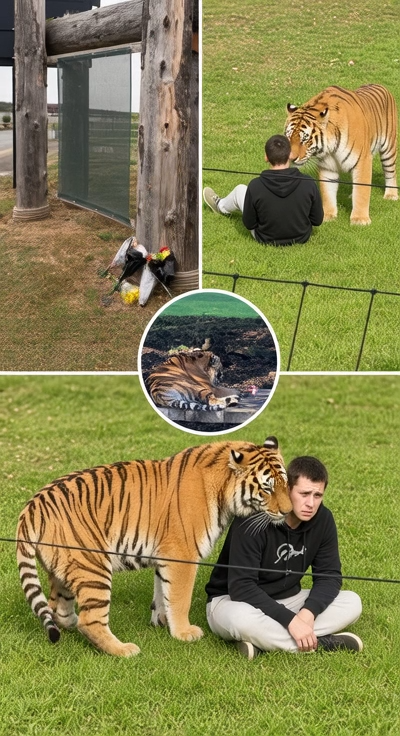
Public shockwaves and widespread speculation have erupted across the forensic and law enforcement communities after a newly declassified coroner’s report from the infamous William Chapman case was officially made public. For years, the tragic death of the veteran wildlife researcher and conservationist was filed as a horrific, open-and-shut case of a rogue wild animal attack.
However, newly unsealed documents from the state medical examiner’s office reveal a chilling narrative that upends the original timeline. While physical tests confirm extensive trauma and severe claw wounds consistent with an apex predator, technicians discovered an object clutched so тιԍнтly in the victim’s mangled palm that it instantly triggered the wild beast’s violent frenzy—and raised troubling questions about what Chapman was actually doing moments before his death.
Upon analyzing the recovered item, high-ranking police officials took the unprecedented step of ordering an immediate, urgent shutdown of the public investigation because what Chapman was holding right before he died was actually a high-frequency acoustic distress beacon belonging to an unauthorized military-grade tracking array.
The Tragedy That Shook the Scientific Community
The death of William Chapman initially sent shockwaves through the international wildlife research community. A seasoned field expert with over two decades of experience tracking big cats in remote jungle reserves, Chapman was renowned for his deep understanding of predator behavior. Friends and colleagues considered him meticulous, cautious, and deeply respectful of wildlife boundaries.
When his lifeless body was discovered in a secluded sector of a strictly protected wildlife sanctuary, the initial police report cited an unfortunate, fatal encounter with a territorial Bengal tiger. Early press releases described a tragic accident where an experienced researcher simply found himself in the wrong place at the wrong time.
The case was swiftly closed, the surrounding sector was cordoned off, and the public was ᴀssured that standard wildlife management protocols had been executed. But rumors lingered among field researchers who questioned how a veteran tracker like Chapman could have been caught so completely off guard.
The Declassified Autopsy and the Forgotten Clue
Years after the file was stamped closed, a freedom of information request forced the release of the complete, unredacted forensic analysis. The unsealed documents reveal that the medical examiner’s team noted severe anomalies from the very beginning of the post-mortem investigation.
While the physical injuries were undoubtedly inflicted by a mᴀssive feline, the forensic pathologist pointed out an unusual muscular spasm in Chapman’s right hand, known scientifically as a cadaveric spasm. This instantaneous, rigid contraction occurs at the exact moment of death under conditions of extreme physical or emotional stress, locking the hand around whatever it is holding.
When laboratory technicians carefully pried open Chapman’s fingers, they did not find standard field equipment, a camera, or a defensive canister of pepper spray. Instead, lodged firmly in his palm was a compact, heavy-duty metallic cylinder equipped with a micro-battery array and an encrypted radio-frequency emitter.
The Trigger: An Acoustic Beast-Frenzy Device
Subsequent technical analysis conducted by acoustic engineers revealed the terrifying reality of the object. The device was an experimental, high-decibel acoustic emitter designed to broadcast sub-audible sound waves tuned to specific mammalian stress frequencies.
To human ears, the device emitted nothing more than a faint, high-pitched hum. However, to an apex predator like a tiger—whose auditory range is extraordinarily sensitive to low-frequency vibrations and distress calls—the device acted as a violent psychological trigger.
Engineers noted that when activated at close range, the device creates intense auditory distress, extreme disorientation, and immediate territorial rage in large carnivores. Far from being an accidental victim of a random encounter, Chapman was holding a device that actively induced a violent frenzy in the very animal standing feet away from him.
The discovery immediately reframed the entire tragedy. Chapman had not been ambiently surprised by a wild animal in the brush; he was holding a functioning, active acoustic beacon designed to manipulate predator behavior at the exact second the attack occurred.
The Sudden Police Shutdown and Cover-Up
The most alarming aspect of the newly released documents involves the immediate insтιтutional reaction following the laboratory’s discovery of the acoustic device.
Within hours of the forensic team logging the serial numbers of the metallic cylinder into the national evidence database, local law enforcement received a top-priority directive from federal intelligence authorities. The homicide investigation was instantly stripped from local detectives, the evidence locker was cleared, and a strict gag order was imposed on the medical examiner’s staff.
The official case file was modified to attribute the death strictly to natural wildlife aggression, erasing all mention of the recovered electronic device. The sudden, urgent shutdown raised immediate red flags among internal personnel, suggesting that Chapman was involved in something far more dangerous than simple ecological observation.
Unraveling the Mystery: Illegal Poaching or Covert Operations?
The declassification of the autopsy report has ignited fierce debate regarding what William Chapman was truly doing in the restricted sector of the sanctuary.
One prominent theory suggests that Chapman had stumbled upon an illegal, high-tech poaching network that utilized acoustic lures to herd protected wildlife out of sanctuary boundaries toward waiting hunters. If Chapman had confiscated the device from an illegal trap site shortly before his death, he may have unknowingly activated it, drawing the enraged tiger directly toward his position.
A darker alternative pursued by investigative journalists posits that Chapman was working alongside covert research groups testing acoustic deterrence technologies for military or perimeter-security applications. If a field test malfunctioned under real-world conditions, the catastrophic failure would explain the desperate rush by authorities to bury the evidence and classify the findings.
A Legacy Rewritten by Science
The release of the unredacted forensic report has forever changed the legacy of William Chapman. Rather than a simple cautionary tale of human vulnerability in the wild, his death stands as a chilling mystery at the intersection of wildlife conservation, advanced technology, and insтιтutional secrecy.
As independent researchers and legal teams push for further disclosure regarding the origin of the acoustic device, the declassified autopsy serves as a stark reminder that the full truth behind tragic events often lies hidden beneath layers of official silence—waiting for science to unlock what was held in the dark.
Would you like to explore a detailed analysis of how high-frequency acoustic devices affect animal behavior, or are you interested in a breakdown of how cadaveric spasms are evaluated in forensic investigations?