🚨😱 A FINAL WARNING BEFORE THE TIGER TRAGEDY? An Alleged Last-Minute Warning Involving William Chapman Raises One Haunting Question: What Was Said Just Seconds Before Disaster?
The Warning That Could Change the Understanding of a Tragedy
The most disturbing detail in the account of William Chapman’s reported fatal tiger encounter is not simply the danger ᴀssociated with entering an enclosure housing one of the world’s most powerful predators.
It is the suggestion that a warning may have been issued shortly before the encounter.
A warning delivered at precisely the wrong moment. A warning that, if confirmed, could raise questions about whether the danger had been recognised before the situation became irreversible.
Yet the crucial details remain missing.
Who supposedly delivered the warning? Was it directed at Chapman? Did he hear it? And, perhaps most importantly, was there any realistic opportunity to respond?
These questions have the potential to transform how the final moments are understood. However, the available account does not establish that such a warning actually occurred.
That distinction is essential. An unverified detail may be compelling, but it cannot be treated as evidence merely because it offers a dramatic explanation for a tragedy.

The Seconds Before Everything Changed
Tiger enclosures are environments where safety depends on carefully maintained physical barriers, controlled access and established procedures.
The animals inside are exceptionally strong, capable of rapid movement and potentially dangerous even when they appear calm.
This makes the circumstances surrounding any unauthorised or unexpected entry into an enclosure particularly important.
In Chapman’s reported case, the central unanswered question concerns the sequence of events immediately before the encounter.
The supplied account places particular emphasis on the possibility of a verbal warning delivered moments beforehand.
If that warning occurred, investigators would need to determine its exact timing and meaning.
A warning issued while someone was approaching a restricted area would have different implications from one shouted after a person had already crossed a protective boundary.
Similarly, an instruction given by a trained member of staff would carry a different evidential significance from an alarm raised by a bystander who had only just noticed the danger.
Without an established timeline, it is impossible to determine which interpretation, if any, is accurate.
But it is precisely this missing sequence that makes the account so troubling.
A Witness Who Reportedly Tried to Stop Him
One of the most significant developments in the reporting concerns a woman who allegedly attempted to physically prevent Chapman from entering the enclosure.
According to witness accounts reported by Sky News and other British outlets, the woman tried to pull him away from the dangerous area but was unable to stop him.
Witness Anthony Hunt said he and his girlfriend later spoke with the woman, who appeared deeply shaken by what had happened.
This account suggests that the danger may have been recognised before Chapman entered the enclosure, rather than only after the tiger approached him.
However, it does not establish precisely what the woman said, whether Chapman understood her intentions or how much time pᴀssed between the attempted intervention and his entry.
Those distinctions could prove important in reconstructing the tragedy.
The reported physical intervention is more specific than the suggestion of a mysterious verbal warning. It indicates that someone may have attempted to prevent the fatal encounter, although the precise circumstances still require careful examination.
The Footage That Captured the Terrifying Approach
Another disturbing element is the footage believed to have been recorded by Chapman himself.
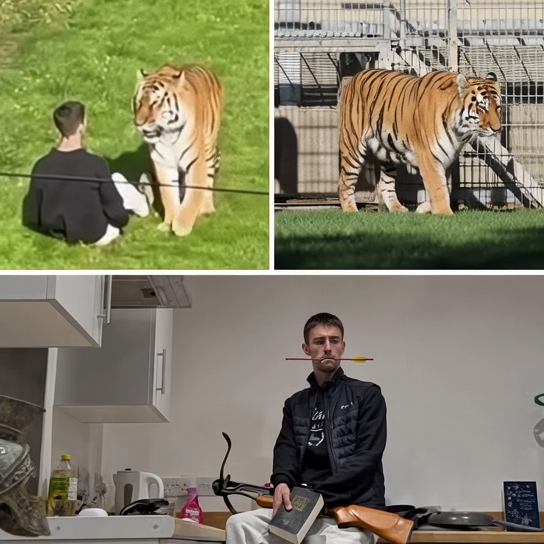
Reports from ITV News describe a short recording apparently made inside the enclosure. It shows the tiger, Altai, resting on a raised wooden structure as the person holding the camera approaches.
In the background, distant voices can be heard reacting with alarm.
The recording offers a glimpse into the atmosphere immediately before the tragedy, but it does not provide a complete explanation of the events leading up to it.
It also raises an important question about the difference between recognising danger and being able to prevent it.
Someone watching from a safe distance may have understood the risk immediately. Chapman, meanwhile, was already inside an environment where the consequences of a sudden movement could be devastating.
The footage should not be interpreted as proof of his intentions or state of mind.
Nor should the voices audible in the recording automatically be treated as the specific final warning described in the original account.
What the Investigation Has Established
The incident occurred on October 10, 2026, at Yorkshire Wildlife Park near Doncaster.
Emergency services were called shortly after 1:30 p.m. following reports that Chapman had entered the tiger enclosure. He was pronounced ᴅᴇᴀᴅ at the scene.
The animal involved was Altai, an Amur tiger housed at the park.
A health and safety investigation was launched by City of Doncaster Council, while the wildlife park confirmed that its emergency response procedures had been activated. The tiger survived the incident and was not scheduled to be euthanised.
An inquest subsequently heard that Chapman had crossed two fences before entering the enclosure. His death was attributed to multiple traumatic injuries.
The inquest also heard evidence concerning his mental health history. His family has asked for privacy and expressed distress over the circulation of graphic material relating to his death.
These findings provide a clearer understanding of the physical circumstances of the tragedy.
They do not, however, establish the precise wording of any final warning or whether an earlier intervention could realistically have prevented the outcome.
The Questions That Remain
For investigators, understanding how Chapman entered the enclosure is only one part of the wider examination.
There are also questions about the barriers, the sequence of events, the response of witnesses and the opportunities available to intervene.
Could the danger have been recognised sooner?
Were there any indications that Chapman intended to enter the enclosure before he approached the barrier?
And what can eyewitness accounts and recordings reliably establish about the final moments?
Such questions deserve examination without ᴀssuming that any individual witness or member of staff was responsible for the tragedy.
The existence of a warning does not automatically mean that there was sufficient time or a safe opportunity to act.
Likewise, a failed attempt to stop someone does not establish that the person intervening could have done more.
A careful reconstruction must distinguish what witnesses observed from what they later inferred.
The Human Tragedy Behind the Headlines
Beyond the recordings, witness accounts and public attention lies the death of a young man whose family has been left facing an extraordinary loss.
Chapman was 24 years old.
His relatives described him as a loved and engaging person and emphasised the importance of allowing the formal investigation to examine the circumstances of his death.
Their statement also highlighted the additional suffering caused by the widespread sharing of distressing footage.
That appeal is a reminder that the tragedy cannot be reduced to a sensational recording or a single unanswered question.
The people who witnessed the encounter must also live with what they saw, including those who reportedly tried to intervene.
For them, the final moments may remain particularly difficult to comprehend.
The Final Warning That Still Demands Clarity
The most haunting possibility in this case is that someone recognised the danger and tried to prevent Chapman from entering the enclosure.
Witness reporting provides a basis for that concern.
What remains uncertain is exactly what was communicated, whether it was understood and whether the sequence of events left any realistic opportunity to change the outcome.
Those are questions for evidence, not speculation.
As the investigation and inquest process continue, the circumstances surrounding Chapman’s final movements may become clearer.
Until then, the alleged last-minute warning remains an important but incompletely documented part of the story.
✓ Team
The Warning That Could Change the Understanding of a Tragedy The most disturbing detail in the account of William Chapman’s reported fatal tiger encounter is not simply…