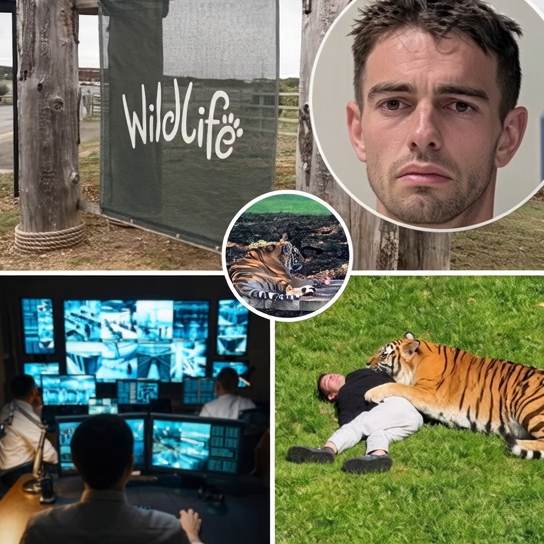
A horrifying zoo incident involving a tiger has become the subject of disturbing online claims, with descriptions of alleged footage focusing attention on the terrifying moments when an encounter with one of nature’s most powerful predators reportedly turned into tragedy.
The account paints an extraordinary picture: frightened visitors, desperate cries, mounting confusion and a camera supposedly capturing the critical moment when the situation took a devastating turn.
But behind the dramatic description lies an important unanswered question.
What actually happened, and does the footage being described show what online audiences are being led to believe?
The original account refers to a tragic incident involving a tiger at a zoo, but provides no confirmed location, date, identification of those involved or independently authenticated recording.
That absence of information is significant, particularly when the claims concern a potentially fatal encounter and footage that could be distressing to viewers.
Nevertheless, the incident described raises serious questions about the unpredictable dangers ᴀssociated with powerful captive predators, the protective measures surrounding their enclosures and the difficulty of understanding a rapidly unfolding emergency from a short video clip.
THE MOMENT AN ORDINARY ZOO VISIT CAN TURN INTO A NIGHTMARE
For most families, a visit to a wildlife attraction offers an opportunity to observe extraordinary animals from a distance.
Tigers are among the most captivating.
Their enormous physical strength, distinctive appearance and commanding movements make them a major attraction at zoological parks around the world.
Yet the same characteristics that make these animals fascinating also demand exceptional caution.
Even tigers born in captivity retain the physical abilities and natural instincts of formidable predators.
Their behaviour can change rapidly, and an encounter that appears calm to an inexperienced observer may involve risks that are not immediately visible.
This is why properly managed wildlife facilities rely on physical barriers, controlled access, trained personnel and carefully established procedures.
In the incident described by the viral caption, however, something reportedly went terribly wrong.
The account suggests that witnesses were confronted with a frightening scene as the animal became involved in a tragic confrontation.
Exactly how that situation developed remains unclear.
There is no verified information in the supplied material establishing whether the incident involved a visitor, a staff member or another person, or whether any protective barrier was breached.
Those details are essential to understanding what happened.
THE ALLEGED FOOTAGE THAT HAS RAISED THE MOST QUESTIONS
Perhaps the most disturbing element of the circulating description is its emphasis on a camera recording the tiger’s movements during the incident.
According to the caption, the lens zoomed toward the animal at a critical moment, supposedly capturing details that would leave viewers horrified.
But the existence, authenticity and contents of such footage have not been established by the information provided.
A dramatic description of a recording is not the same as a verified video.
Even when genuine footage exists, a short clip can offer only a narrow view of a much larger event.
It may fail to show what happened before filming began, what safety measures were in place or how staff responded outside the camera’s frame.
A sudden movement by an animal can also be difficult to interpret without understanding the surrounding circumstances.
For that reason, video evidence must be ᴀssessed alongside reliable eyewitness accounts, official records and any subsequent investigation.
The central question is not simply what the camera may have captured.
It is whether the recording, if authenticated, can establish the sequence of events that led to the tragedy.
THE REAL INCIDENT THAT BROUGHT THE FOOTAGE INTO FOCUS
A documented tragedy at Yorkshire Wildlife Park in Doncaster, England, on October 10, 2026, provides important context for the account.
William Chapman, 24, died after entering an enclosure occupied by an Amur tiger named Altai.
Emergency services were called shortly after 1:30 p.m., but Chapman was pronounced ᴅᴇᴀᴅ at the scene.
Reports from ITV News, Sky News and the BBC describe footage apparently recorded by Chapman himself as he approached the animal.
The recording reportedly shows the tiger resting on a raised wooden platform while distant visitors react in alarm.
Witnesses also described attempts to warn Chapman and distract the animal. However, reports do not substantiate the caption’s claim that hundreds of people witnessed the incident or that the camera zoomed in to capture the fatal attack. <Cite refs={[“turn881478search1″,”turn881478search2″,”turn881478search5”]}/>
THE QUESTIONS INVESTIGATORS MUST NOW ANSWER
Following Chapman’s death, Doncaster City Council launched a health and safety investigation.
Among the important questions are how he gained access to the enclosure, whether existing barriers operated as intended and what circumstances contributed to the fatal encounter.
The park temporarily closed while the incident was examined and staff received support.
On October 15, Yorkshire Wildlife Park announced that it would reopen the following day. Management confirmed that Altai was safe and would not be euthanised, while enquiries into the tragedy continued. <Cite refs={[“turn881478search0″,”turn881478search3”]}/>
BEHIND THE DISTURBING IMAGES, A FAMILY’S DEVASTATING LOSS
As footage circulated online, Chapman’s family appealed for the public to stop sharing distressing recordings.
They described William as a dearly loved young man and asked that the circumstances of his death be examined respectfully.
Their appeal highlights a painful reality: behind every viral clip of a tragedy are relatives confronting a loss that no amount of online attention can undo. <Cite refs={[“turn881478search7″,”turn881478news15”]}/>
The tiger survived. The wildlife park reopened. But the investigation into the circumstances of William Chapman’s death remains a matter of profound importance.
And the most consequential question is not what the camera captured in those final moments, but whether a fuller examination of the evidence can explain how an ordinary afternoon at a wildlife park ended in such devastating circumstances.